From Technical Controls to Security Decisions: An Eight-Domain Learning Journey
How completing Infosec’s CISSP specialization connects infrastructure knowledge with risk, accountability, and the purpose behind a security control.

Rizwan Syed
3 min read
A security control has a technical configuration, but it also has a purpose: protecting something the organization values. Understanding both sides is central to how I approach my development as a security professional. On October 17, 2026, I completed Infosec’s eight-course CISSP specialization on Coursera, a learning milestone that connects technical decisions with the wider responsibilities of a security program.
Seeing the broader security program
My background includes enterprise systems, networking, identity, and automation. Each area offers a detailed view of how technology operates. A broad security learning path adds another perspective: how those systems relate to risk, ownership, policy, and the needs of the organization. That wider view helps give individual technical choices a meaningful context.
The specialization covered all eight CISSP domains, moving from security and risk management through asset protection, architecture, networks, identity, assessment, operations, and software development security. Completing the sequence created a structured way to connect subjects that are sometimes discussed separately, even though their consequences often overlap.
Following the connections between domains
Access management offers a useful example. Creating an account is a technical action, but deciding what it should be able to do involves the value of the information, the person’s responsibilities, and the organization’s rules. Reviewing that access later brings in oversight, evidence, and operational discipline. Several areas of security meet in one familiar workflow.
I find that connected perspective useful because it changes the questions worth asking. Who owns the decision? What needs protection? How will the control be reviewed? The technical implementation still matters, and its role becomes clearer when it is connected to the objective it is meant to support.
Connecting architecture with accountability
A thoughtful security design should be understandable to the people who maintain it and to the people who depend on it. That means being able to explain the requirement, the selected approach, and how its effectiveness will be checked. The same principle applies whether the discussion concerns identity, recovery, a network boundary, or a software change.
For my own work, this is a useful standard of communication. Technical detail should help someone understand the decision and their responsibility within it. A diagram, a procedure, or an automation tool becomes more useful when the assumptions are visible and the intended outcome is clear enough to review.
Carrying a wider perspective forward
Completing Infosec’s eight-course specialization through Coursera gave this learning journey a tangible milestone. Across the domains, the recurring theme was connection: assets to responsibilities, architecture to risk, and operations to evidence. Bringing those relationships into the same frame makes the broader security program easier to reason about.
The perspective I want to carry forward is straightforward: understand the system, understand what matters to the organization, and make the connection explicit. That is how continued study can support stronger professional judgment. For me, this milestone represents an investment in seeing security as a shared responsibility, with technical skill and clear reasoning working together to support it.
What I take forward
Security decisions become more useful when the technical control, the organizational purpose, and the responsibility for reviewing it are all clear.
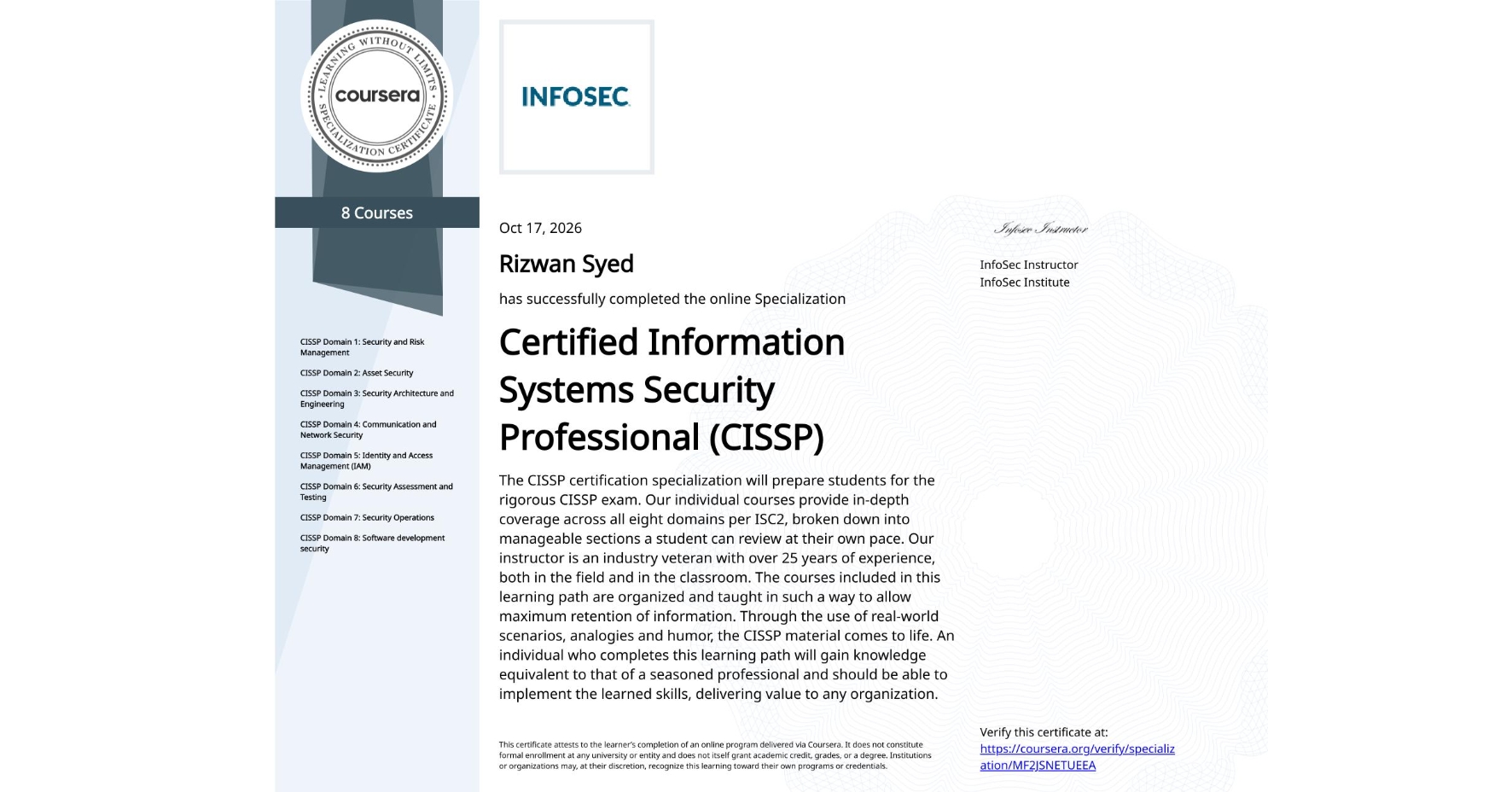
Specialization certificate
Certified Information Systems Security Professional (CISSP) — Coursera Specialization
- Issued by
- Infosec · Coursera
- Completed
- Credential ID
- MF2JSNETUEEA
Infosec specialization certificate for completing eight courses across the CISSP domains, from security and risk management to software development security. A separate learning credential from the ISC2 professional certification.
Explore the learning behind this story
Continue the journey
View all stories
Learning journal · 3 min read
From Security Alerts to Clearer Decisions: My Generative AI Learning Journey
What completing IBM’s cybersecurity AI course taught me about useful automation, evidence, and keeping human judgment at the center of security work.

Learning journal · 3 min read
Beyond Knowing the Answer: Building Sharper Cybersecurity Judgment
My reflections on IBM’s Security+ and CySA+ assessment course, and the value of turning technical knowledge into clear, defensible decisions.