From Security Alerts to Clearer Decisions: My Generative AI Learning Journey
What completing IBM’s cybersecurity AI course taught me about useful automation, evidence, and keeping human judgment at the center of security work.

Rizwan Syed
3 min read

A security alert can arrive with plenty of data and very little clarity. The difficult part is deciding what deserves attention, what the evidence actually supports, and what should happen next. That is the lens I bring to generative AI. Completing IBM’s Generative AI: Boost Your Cybersecurity Career on October 19, 2026, gave me a structured way to explore its place in that decision-making process.
Starting with the security problem
My professional background spans enterprise infrastructure, cybersecurity, and automation. Those areas meet at a practical challenge: useful information is often distributed across tools, logs, documentation, and people. Bringing it together takes technical understanding and clear communication. AI becomes interesting when it helps with that work in a way an analyst can inspect.
The course connected generative AI fundamentals with security use cases, including threat intelligence, behavior analysis, report summarization, and response playbooks. Seeing those subjects together gave the learning a clear direction. The question was how a generated output could support an accountable security decision, with the underlying evidence still visible.
Following information to a decision
Consider an analyst reviewing several incident notes. A useful summary would preserve the timeline, affected assets, observed behavior, and unresolved questions. It would also distinguish a confirmed event from an assumption. This is the kind of practical standard I use to think about AI-assisted security work: the output should make careful review easier.
The learning path also explored the threat side of the technology, from phishing and malicious content to attacks directed at AI systems. That connection matters. A tool that processes untrusted information needs boundaries around what it can see and do, especially when generated text might influence an investigation or an automated workflow.
Keeping judgment in the process
One principle I take from this achievement is that speed needs a review process. Before using an AI-generated recommendation, I want to know where its evidence came from, whether important context is missing, and how the recommendation could be checked. A fluent explanation is a starting point for scrutiny.
For someone who builds automation, this is a valuable design perspective. A responsible workflow should make it straightforward to review inputs, trace a conclusion, and stop an inappropriate action. Those are useful questions to ask before connecting a model to an operational tool, regardless of how impressive the first demonstration looks.
What this milestone adds to my work
Earning this course certificate adds a focused AI learning milestone to my broader security and infrastructure experience. It gives me a clearer vocabulary for discussing where generative AI may assist an analyst, and where access controls, careful validation, and human responsibility remain central to the design.
The direction I want to carry forward is practical: start with a well-defined security task, establish how success will be evaluated, and keep the result reviewable. Whether the task is making a report clearer or organizing investigation context, the value lies in helping people reach better-supported decisions. That is the standard I want my technical work to meet.
What I take forward
AI earns a useful place in security when its contribution can be checked, explained, and connected to a responsible decision.
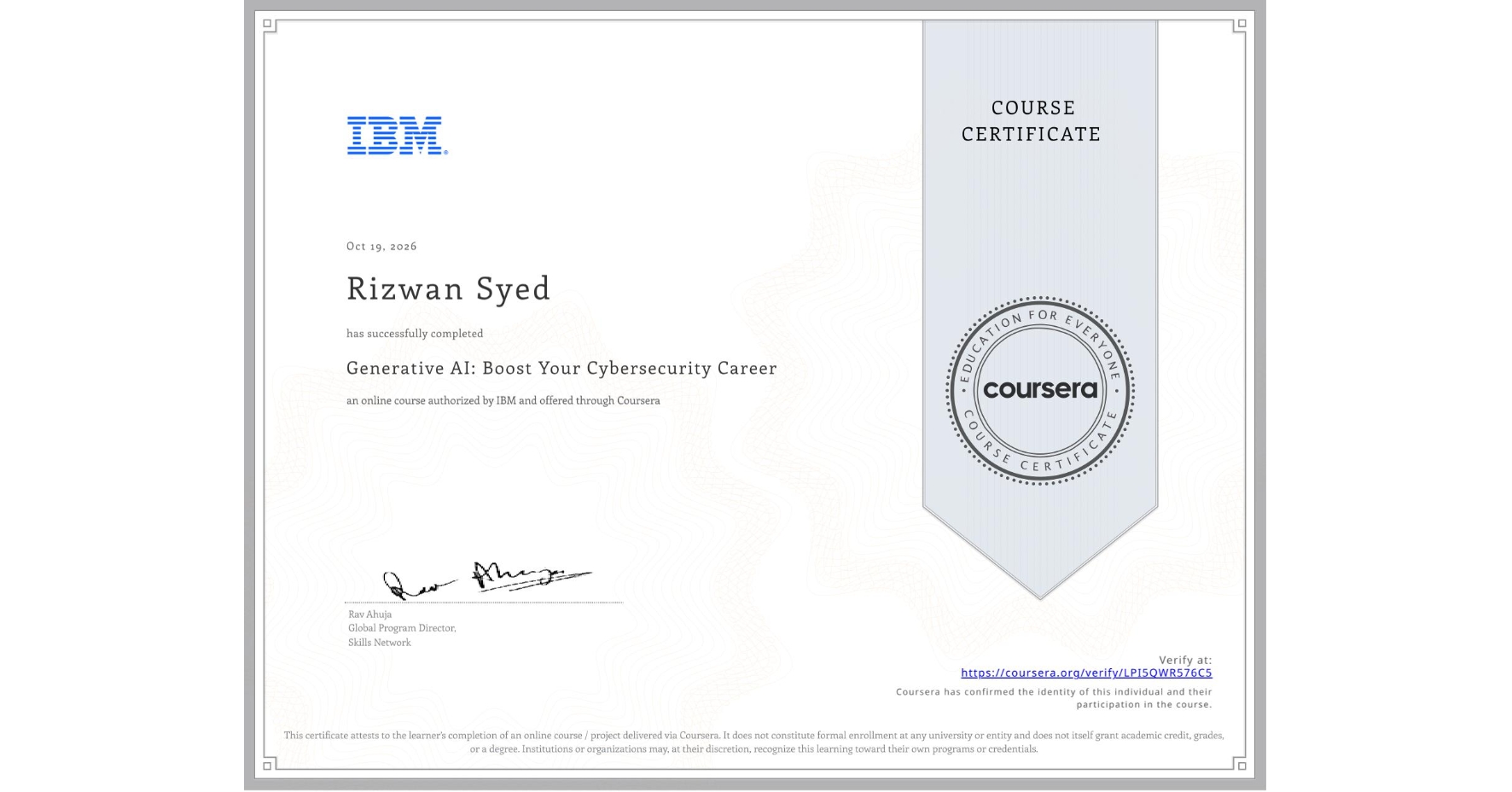
Course certificate
Generative AI: Boost Your Cybersecurity Career
- Issued by
- IBM · Coursera
- Completed
- Credential ID
- LPI5QWR576C5
IBM course certificate covering generative AI in security analysis, threat intelligence, incident-response documentation, and the security of AI systems.
Explore the learning behind this story
Continue the journey
View all stories
Learning journal · 3 min read
Beyond Knowing the Answer: Building Sharper Cybersecurity Judgment
My reflections on IBM’s Security+ and CySA+ assessment course, and the value of turning technical knowledge into clear, defensible decisions.

Learning journal · 3 min read
Following the Packet: My Journey Through the CCNA Learning Path
Three courses, one connected perspective: how Packt’s networking specialization brings access, routing, security, and automation into the same picture.